Fearful-Avoidant Attachment
You want closeness but also fear it
Estimated prevalence: ~3-5% of adults
Not sure if this is your style? Take the free quiz →
What Is Fearful-Avoidant Attachment?
Also known as disorganised attachment, fearful-avoidant attachment is characterised by a deep conflict: you desperately want love and connection, but you're also deeply afraid of being hurt. This creates a push-pull pattern where you alternate between seeking closeness and pushing it away.
Key Signs of Fearful-Avoidant Attachment
- Intense desire for love mixed with fear of intimacy
- Push-pull behaviour in relationships
- Difficulty trusting others consistently
- Emotional intensity and unpredictability
- May sabotage relationships when things go well
- Often confused about what you actually want
Fearful-Avoidant Attachment in Relationships
Your relationships often feel like a rollercoaster. You might pursue someone intensely, then suddenly pull away when things get serious. Partners may describe you as 'hot and cold' or feel like they're walking on eggshells.
What Causes Fearful-Avoidant Attachment?
Fearful-avoidant attachment often develops in response to frightening, confusing, or traumatic early caregiving. Your caregiver may have been a source of both comfort and fear, creating an impossible situation: the person you needed to go to for safety was also the person you needed to get away from. This creates deeply conflicting impulses around closeness that persist into adulthood.
Common Challenges
The fundamental challenge is that your attachment system sends contradictory signals — 'come closer' and 'go away' at the same time. This often stems from early experiences where your source of comfort was also a source of fear.
How to Heal Fearful-Avoidant Attachment
Healing fearful-avoidant attachment often benefits most from professional support, as it's frequently linked to early trauma. Therapy modalities like EMDR, somatic experiencing, or attachment-focused therapy can help.
Practical Steps
- Seek professional support: Given the trauma origins of this style, working with a therapist trained in attachment theory is strongly recommended.
- Map your patterns: Track when you shift between wanting closeness and pushing away. What triggers each shift?
- Build safety slowly: Secure attachment develops through repeated small experiences of safety, not through one dramatic breakthrough.
- Practice emotional regulation: Grounding techniques, breathwork, and somatic practices can help you manage the intensity of your emotional swings.
- Be patient with yourself: Healing from fearful-avoidant attachment is a longer journey, but it's absolutely possible. Progress isn't linear.
Save & Share This Guide
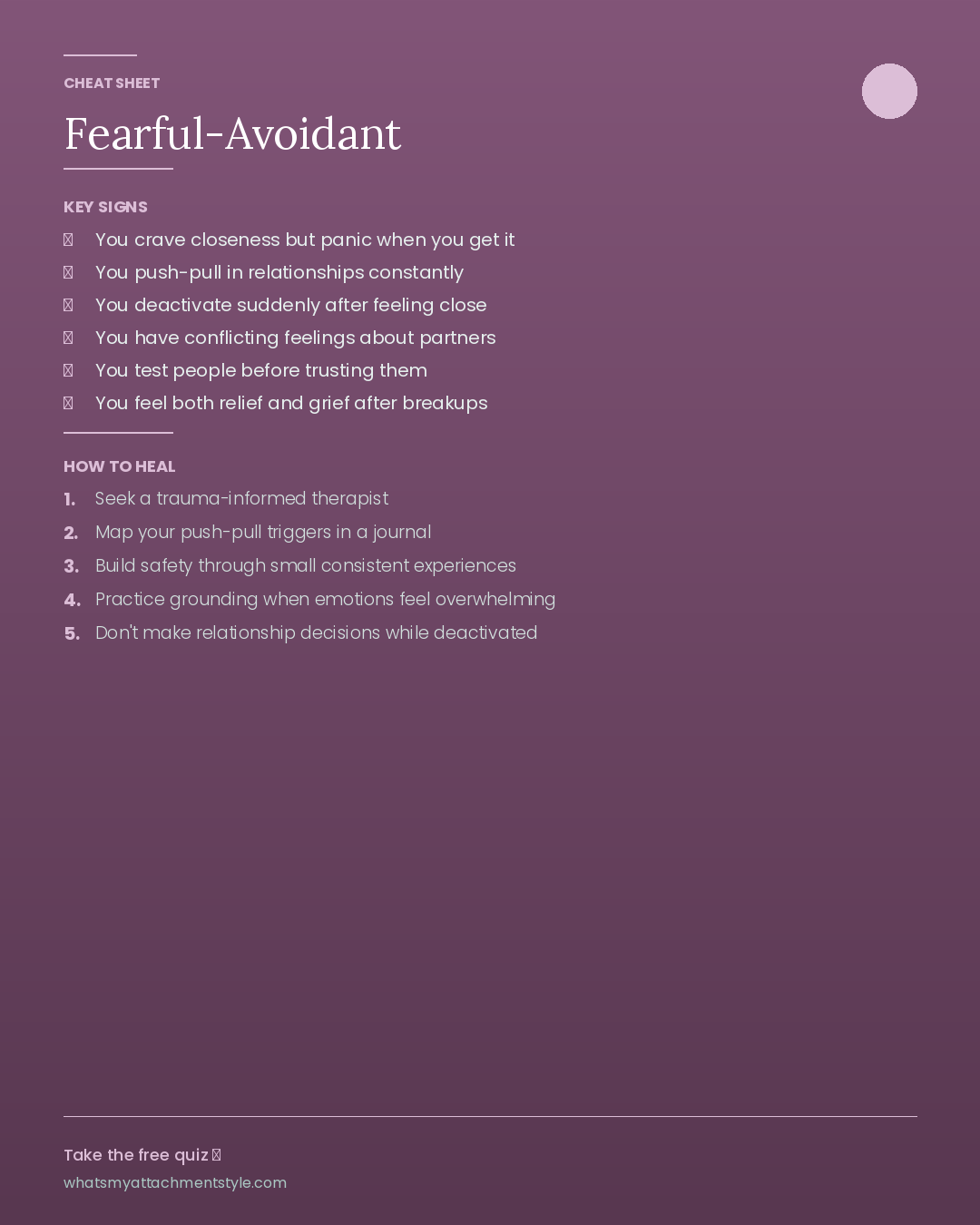
Screenshot this cheat sheet and share it with someone who needs it.
Want to explore this with a professional?
Talk to a Licensed Therapist
Online therapy can help you understand your attachment patterns and build healthier relationships.
Affiliate link — we may earn a commission at no extra cost to you.
Our Book
What's My Attachment Style?
The complete guide to understanding your attachment patterns and building healthier relationships.
Related Scenarios
Fearful-Avoidant Deactivating
Understanding the fearful-avoidant deactivation process.
Fearful-Avoidant Push-Pull Cycle
Why fearful-avoidants cycle between wanting closeness and pushing away.
Fearful-Avoidant After a Breakup
The chaotic grief of a fearful-avoidant breakup.
Fearful-Avoidant Hot and Cold
Understanding extreme mood shifts in fearful-avoidant attachment.
Fearful-Avoidant and Trust Issues
Why trust feels impossible with fearful-avoidant attachment.
Fearful-Avoidant Self-Sabotage
Why you destroy good relationships when things are going well.
Fearful-Avoidant In New Relationships
The overwhelming intensity of new love with fearful-avoidant attachment.
Fearful-Avoidant and Abandonment
The simultaneous fear of being left and being consumed.
Understand Other Styles
Compatibility
Fearful-Avoidant + Anxious
VolatileAn intensely emotional pairing where both partners' worst fears can be triggered.
Fearful-Avoidant + Avoidant
ChallengingThe fearful-avoidant's need for closeness clashes with the avoidant's need for distance.
Fearful-Avoidant + Secure
HealingA secure partner can provide the consistent safety a fearful-avoidant needs to begin healing.
Fearful-Avoidant + Fearful-Avoidant
ChaoticTwo fearful-avoidants can create an intensely passionate but deeply unstable dynamic.
Key Resources
Take the Attachment Style Quiz
Discover your style in 5 minutes with our free quiz.
What's My Attachment Style? — The Book
The complete guide with exercises, scripts, and a 30-day programme.
Recommended Books on Attachment
Our top picks for deeper understanding.
Therapy for Attachment Issues
How professional support can accelerate your healing.
What's Your Attachment Style?
Take our free 5-minute quiz to discover your attachment style and get personalised insights.
Take the Free Quiz →