Anxious Attachment
You crave closeness but fear abandonment
Estimated prevalence: ~20% of adults
Not sure if this is your style? Take the free quiz →
What Is Anxious Attachment?
People with an anxious attachment style have a strong desire for closeness and intimacy, but are often preoccupied with worries about whether their partner truly loves them. You tend to be highly attuned to your partner's moods and behaviours, sometimes reading into things that aren't there.
Key Signs of Anxious Attachment
- Strong desire for closeness and reassurance
- Highly sensitive to partner's mood changes
- Fear of abandonment or rejection
- Tendency to overthink and analyse relationship signals
- May become clingy or people-pleasing when anxious
- Deeply loving and emotionally expressive
Anxious Attachment in Relationships
You love deeply and are incredibly attuned to your partner's emotional state. However, you may find yourself constantly seeking reassurance, checking your phone for messages, or feeling anxious when your partner needs space.
What Causes Anxious Attachment?
Anxious attachment typically develops when caregiving in childhood was inconsistent. Your caregiver may have been loving and attentive at times, but unavailable or distracted at others. This unpredictability taught you that love is unreliable and you need to work hard to keep it. You learned to amplify your emotional signals — crying louder, clinging tighter — to get the attention you needed. As an adult, this pattern shows up as hypervigilance in relationships, constantly scanning for signs that your partner might leave.
Common Challenges
The biggest challenge is the anxiety spiral: you sense distance, become anxious, seek reassurance in ways that push your partner further away, which confirms your fears.
How to Heal Anxious Attachment
Healing anxious attachment involves building a stronger sense of self-worth that isn't dependent on your relationship. Practices like journaling, therapy, mindfulness, and learning to self-soothe can help you develop 'earned security.'
Practical Steps
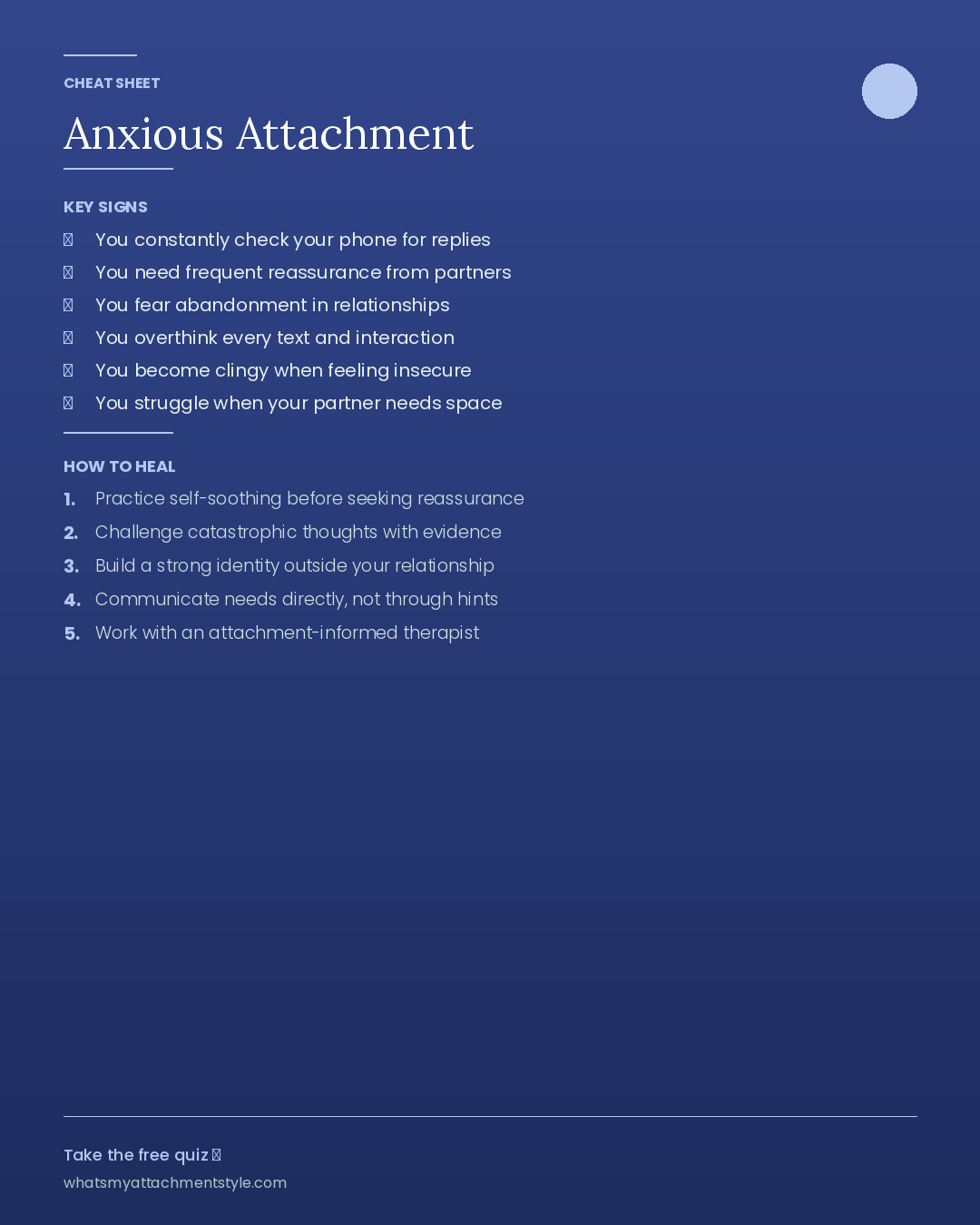
- Notice your triggers: Start tracking what specific situations activate your anxiety. Is it a delayed text? A cancelled plan? Awareness is the first step.
- Practice self-soothing: Before reaching out for reassurance, try pausing for 10 minutes. Journal, breathe, or go for a walk. Build your capacity to comfort yourself.
- Challenge catastrophic thoughts: When your mind spirals to “they're going to leave me,” ask yourself: what's the actual evidence? What would I tell a friend in this situation?
- Communicate needs directly: Instead of testing your partner or hinting, practice saying “I need some reassurance right now” or “I'm feeling anxious — can we talk?”
- Build a life outside your relationship: Invest in friendships, hobbies, and goals that give you a sense of identity beyond your partnership.
Save & Share This Guide
Screenshot this cheat sheet and share it with someone who needs it.
Want to explore this with a professional?
Talk to a Licensed Therapist
Online therapy can help you understand your attachment patterns and build healthier relationships.
Affiliate link — we may earn a commission at no extra cost to you.
Our Book
What's My Attachment Style?
The complete guide to understanding your attachment patterns and building healthier relationships.
Related Scenarios
Anxious Attachment When He Doesn't Text Back
Why not getting a text triggers your anxious attachment and what to do about it.
Anxious Attachment After a Breakup
How anxious attachment makes breakups feel unbearable and how to cope.
Anxious Attachment In Long Distance Relationships
Managing anxious attachment when your partner is far away.
Anxious Attachment In a New Relationship
Why new relationships trigger anxious attachment and how to stay grounded.
Anxious Attachment When Your Partner Needs Space
How to manage the panic when your partner asks for alone time.
Anxious Attachment After an Argument
Why arguments feel catastrophic with anxious attachment.
Anxious Attachment and Jealousy
Understanding why jealousy is so intense with anxious attachment.
Anxious Attachment and Overthinking
Breaking the cycle of anxious overthinking in relationships.
Understand Other Styles
Compatibility
Anxious + Avoidant
ChallengingThe most common insecure pairing. The anxious partner pursues while the avoidant partner withdraws, creating an intensifying cycle.
Anxious + Secure
PromisingA secure partner can help an anxious partner feel safe enough to develop earned security over time.
Anxious + Anxious
IntenseBoth partners crave closeness, which can feel wonderful — but mutual anxiety can amplify fears.
Fearful-Avoidant + Anxious
VolatileAn intensely emotional pairing where both partners' worst fears can be triggered.
Key Resources
Take the Attachment Style Quiz
Discover your style in 5 minutes with our free quiz.
What's My Attachment Style? — The Book
The complete guide with exercises, scripts, and a 30-day programme.
Recommended Books on Attachment
Our top picks for deeper understanding.
Therapy for Attachment Issues
How professional support can accelerate your healing.
What's Your Attachment Style?
Take our free 5-minute quiz to discover your attachment style and get personalised insights.
Take the Free Quiz →