Avoidant Attachment
You value independence and find closeness uncomfortable
Estimated prevalence: ~25% of adults
Not sure if this is your style? Take the free quiz →
What Is Avoidant Attachment?
People with an avoidant attachment style place a high value on independence and self-sufficiency. You may find it difficult to depend on others or allow others to depend on you. Emotional closeness can feel uncomfortable or threatening, even when you care deeply about your partner.
Key Signs of Avoidant Attachment
- Strong need for independence and autonomy
- Discomfort with emotional vulnerability
- Tendency to withdraw when things get intense
- May dismiss the importance of relationships
- Difficulty expressing emotions or needs
- Often perceived as aloof or emotionally distant
Avoidant Attachment in Relationships
You may genuinely care about your partner but struggle to show it in ways they need. When conversations get emotional or your partner asks for more closeness, you might shut down, change the subject, or physically withdraw.
What Causes Avoidant Attachment?
Avoidant attachment usually develops when caregivers were emotionally distant, dismissive of emotions, or uncomfortable with displays of need. You learned early that expressing vulnerability led to rejection or discomfort, so you adapted by becoming self-reliant and suppressing your emotional needs. As an adult, this manifests as discomfort with closeness, difficulty expressing feelings, and a strong preference for independence in relationships.
Common Challenges
The core challenge is that your need for space often gets interpreted as rejection by your partner. You may cycle through relationships, feeling drawn to someone initially but pulling away as things deepen.
How to Heal Avoidant Attachment
Healing avoidant attachment means gradually learning that vulnerability isn't weakness and that depending on others doesn't mean losing yourself. Start small — share one feeling per day, stay present during difficult conversations.
Practical Steps
- Start small with vulnerability: Share one feeling per day with your partner. It doesn't have to be deep — even “I felt stressed at work today” is a start.
- Notice when you withdraw: Pay attention to the moments you want to shut down or pull away. What triggered it? What are you protecting yourself from?
- Stay present during conflict: When a difficult conversation starts, resist the urge to leave, stonewall, or change the subject. Staying present is a skill you can build.
- Challenge your independence narrative: Needing others isn't weakness. Interdependence — the ability to rely on others while maintaining autonomy — is the goal.
- Appreciate your partner's bids for connection: When your partner reaches out, try to receive it positively rather than seeing it as an imposition.
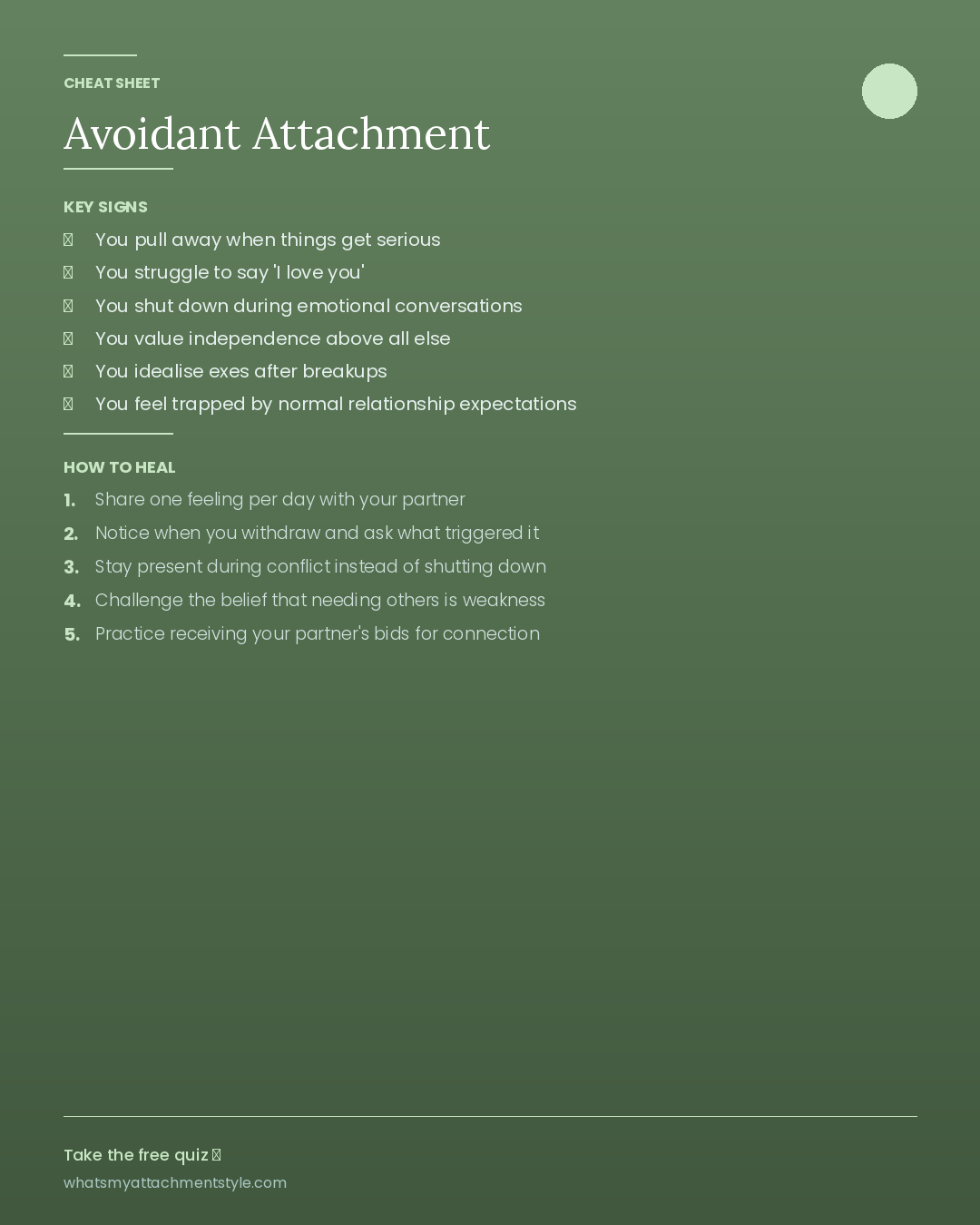
Save & Share This Guide
Screenshot this cheat sheet and share it with someone who needs it.
Want to explore this with a professional?
Talk to a Licensed Therapist
Online therapy can help you understand your attachment patterns and build healthier relationships.
Affiliate link — we may earn a commission at no extra cost to you.
Our Book
What's My Attachment Style?
The complete guide to understanding your attachment patterns and building healthier relationships.
Related Scenarios
Avoidant Attachment After an Argument
Why avoidant partners shut down after conflict.
Avoidant Attachment Texting Patterns
Understanding how avoidant attachment shows up in texting.
Avoidant Attachment and Commitment
Why commitment feels threatening with avoidant attachment.
Avoidant Attachment When Things Get Serious
The avoidant tendency to pull away as relationships deepen.
Avoidant Attachment and Ghosting
Understanding why avoidant partners sometimes disappear.
Avoidant Attachment and Intimacy
Why emotional and physical intimacy feels threatening.
Avoidant Attachment Hot and Cold Behaviour
Why avoidant partners seem interested one day and distant the next.
Avoidant Attachment and Vulnerability
Why being vulnerable feels dangerous with avoidant attachment.
Understand Other Styles
Compatibility
Anxious + Avoidant
ChallengingThe most common insecure pairing. The anxious partner pursues while the avoidant partner withdraws, creating an intensifying cycle.
Avoidant + Secure
PromisingA secure partner can provide the space an avoidant needs while modelling healthy vulnerability.
Avoidant + Avoidant
DistantBoth partners value independence, which can work — but emotional intimacy may never develop.
Fearful-Avoidant + Avoidant
ChallengingThe fearful-avoidant's need for closeness clashes with the avoidant's need for distance.
Key Resources
Take the Attachment Style Quiz
Discover your style in 5 minutes with our free quiz.
What's My Attachment Style? — The Book
The complete guide with exercises, scripts, and a 30-day programme.
Recommended Books on Attachment
Our top picks for deeper understanding.
Therapy for Attachment Issues
How professional support can accelerate your healing.
What's Your Attachment Style?
Take our free 5-minute quiz to discover your attachment style and get personalised insights.
Take the Free Quiz →